The main contribution to this piece’s analysis comes from Rob Nixon's concept of slow violence. This idea was developed in “Slow Violence and the Environmentalism of the Poor”(2011).
Here, he characterises it as destruction that takes place gradually and out of sight. Violence of this nature, he argues, is difficult to link to a clear cause, timeline, perpetrator, and victim.
The clearest case of herbicidal warfare is US' Operation Ranch Hand in Vietnam; Stellman et al. produced a comprehensive quantitative assessment of the operation's scope and the dispersal of Agent Orange/related defoliants across around 4.5 million acres of land during 1962-1971.
The goal was to destroy crops and cut the Viet Cong's local support networks. The operation had serious long-term consequences; dioxin compounds remained in the ecosystem for decades and a health crisis emerged that impacts around 4 million Vietnamese people today. Richard Falk was one of the first scholars to argue that the intentional destruction of civilian food supplies using herbicides was a violation of the laws of war. His work was crucial and has been built upon by subsequent scholars.
When it comes to international humanitarian law and its capability to address environmental harm, the scholarship is also well developed. However, it is limited in its link with herbicidal warfare specifically. Yoram Dinstein's The Conduct of Hostilities under the Law of International Armed Conflict (2004) provides the most authoritative treatment of the legal constraints on environmental damage in warfare, examining existing international law and their limitations.
While several scholars have examined reasons why human security has failed to generate binding obligations, it has not yet been applied specifically to the case of herbicidal warfare as a mechanism of food and environmental insecurity as is done by Israel.
The most directly relevant empirical work on Israel's herbicidal operations has been produced not by academic scholars but by investigative organisations. Forensic Architecture's investigations into herbicidal drift along the Gaza perimeter, conducted in collaboration with the Al Mezan Center for Human Rights, Gisha, and Adalah, represent the most methodologically rigorous documentation of Israeli herbicidal operations to date and have introduced satellite-based remote sensing and drift modelling as evidentiary tools for establishing cross-border contamination. PAX's reporting on cross-border spraying in Syria and Lebanon, alongside investigative work published by Syria Direct, has extended this evidentiary record as well.
Record of Israel's herbicidal operations along the Lebanon's border has been reported by multiple sources, including Lebanese governmental authorities/representatives11, environmental NGOs like Green South Lebanon12, journalists at outlets such as Middle East Eye13 and the Lebanese newspaper L'Orient Today14. Briefings to UN bodies such as the United Nations Interim Force in Lebanon15 (UNMIL) have also made note of these actions.
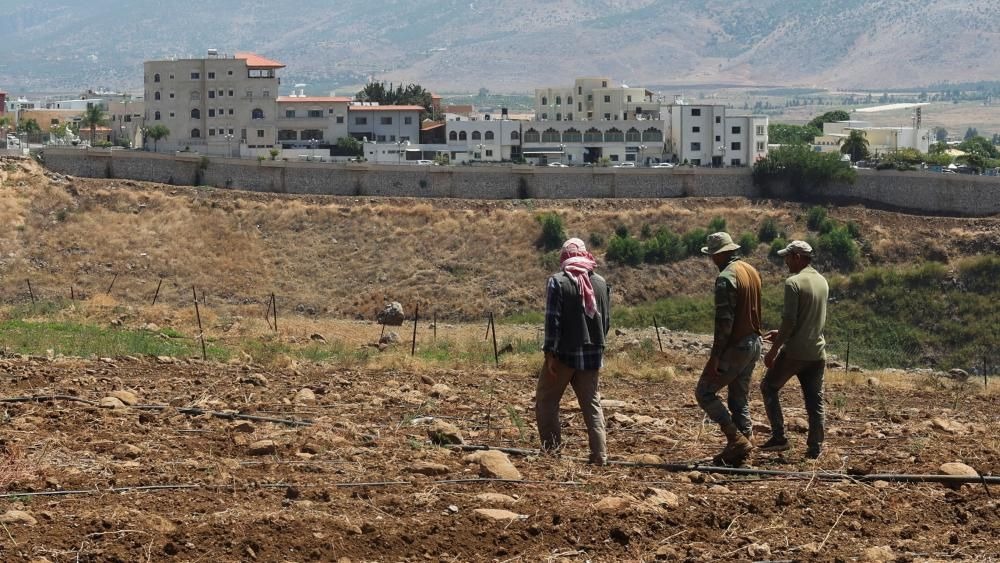
The operations take place along the Blue Line (this is the boundary marked by the UN after Israel's withdrawal from Lebanon in 2000). Reports indicate that Israel’s planes have sprinkled herbicides across agricultural land, forests, as well as livestock grazing areas. Local farmers have raised concerns that their crops began turning yellow only days after they first saw the spraying. This discolouration indicated damage to crops/grazing lands and worsened in the weeks that followed16. The affected crops in southern Lebanon include those on which small-holder farming communities depend, such as olive groves, tobacco, and other crops.17 In fact, areas like Kodna showed visible vegetation decrease, which further raised concerns.
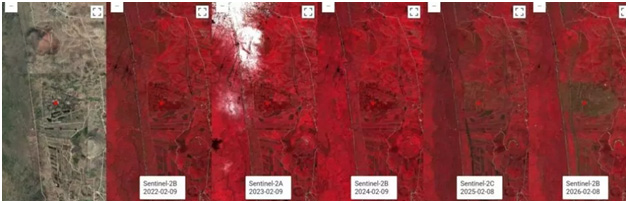
Note: Infrared imagery from the Sentinel-2 satellite of the Kodna region, situated east of the Alpha line, reveals a notable decline in dense vegetation cover since February 2022. Source: From the Copernicus program; collected by He Yin. |
Lebanon's Ministries of Agriculture and Environment warned that chemical concentrations at the documented levels risk further degrading soil conditions. This could damage vegetation and also threaten already strained water resources. It is also important to keep in mind that due to the broader conflict, these agricultural communities are already extremely vulnerable. A FAO damage and loss assessment found that the country’s agriculture sector lost a total of $604 million in damages and losses from 2023-2024. South Lebanon and the Beka Valley were hit hardest.
18
In fact, UNIFIL has come out to state that the IDF's operations have hindered peacekeepers' ability to perform their duties. They also went on to say that it also potentially puts at risk their and civilians’ health.
19 The UN Human Rights Office also described the operations as a serious risk to civilians. It also emphasized that any IDF activity beyond the Blue Line violates Resolution 1701.
20 The IDF pushed back by justifying their actions as standard security procedures to eliminate overgrowth that could be exploited by adversaries to hide advancement. It was also stated that the chemicals used were herbicides that are normally allowed. However, no information on their formulation or hazardousness was provided.
21 Israeli officials have not directly addressed allegations of international legal violations.
b) Syria
In contrast to Lebanon, the circumstances in Syria are more complex. This is largely due to the presence of multiple armed actors in the border regions, such as rebel groups, Islamic State remnants, etc.
22 This makes attribution difficult. Nevertheless, Israeli military operations in Syria have been extensively documented, including by the IDF itself; they have periodically acknowledged conducting strikes against what it characterises as Iranian-linked weapons transfers and military infrastructure.
23 Civil society groups and international media have reported on the destruction of agricultural areas for military purposes by Israel as well.
24
The region of Quneitra governorate (territory adjacent to the Israeli-occupied Golan Heights) has been a major focus area. Quneitra used to be among Syria's more agriculturally productive regions, known for its chickpeas, lentils, and wheat cultivation; around 70% of the crops produced were for these purposes.
25 By 2022, according to a Food and Agriculture Organisation assessment, agricultural production in Syria had declined by 75% relative to pre-conflict levels. The FAO report attributed this collapse to multiple factors including conflict damage, displacement, input shortages, and water system destruction. The report, however, did not (and, given the political constraints on UN agency operations, could not) formally attribute this to Israeli operations specifically targeting agricultural infrastructure.
26 However, recent satellite and normalised difference vegetation index (NDVI) imagery analysis as well as advanced vegetation index (AVI) along with soil adjusted vegetation index (SAVI) tests conducted by researchers at Syria Direct documented patterns of vegetation loss in Quneitra that are correlated with Israeli aerial operations, including agricultural destruction that appear to have occurred during periods of relative peace.
27
In early 2026, according to the Quneitra Agricultural Directorate, the damage encompassed hundreds of dunams of cultivated land and several thousand dunams of grazing land, with farmers reporting substantial losses to wheat, barley, olive trees, and livestock feed crops.
28 The testimony is in line with the case in Lebanon, where there is characteristic herbicidal damage, chemical residues on plant tissue, timing correlated with Israeli aerial activity, and little alternative causal explanation identified by affected communities or by agricultural experts who have reviewed the evidence.
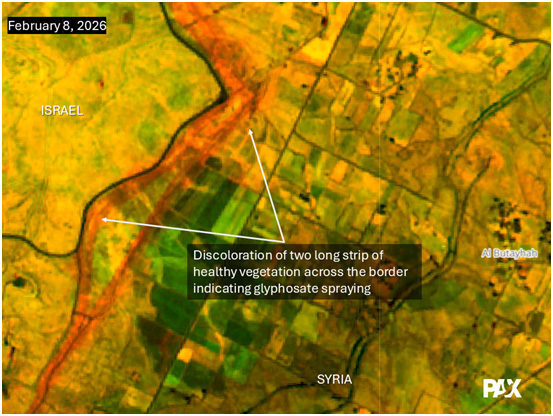
Note: Image illustrates glyphosate spraying along Israel’s border with Syria. |
The Legal Frameworks & Gaps
a) The Chemical Weapons Convention (CWC)
The CWC, which came into force in 1997 and has been ratified by 193 states parties, is the primary international instrument regulating the utilization of chemicals in conflicts.
29 The CWC defines a 'chemical weapon' by reference to a 'toxic chemical'; it includes any agent that can cause fatality, temporary impairment/disability, or permanent damage to humans or animals.
30 Crucially, Schedule 3 of the CWC does not include commercial herbicides commonly used in agricultural-destruction operations. Glyphosate, the active ingredient in Roundup and the compound whose residues have been detected in Lebanese and Syrian border soil samples, is actually not scheduled under the CWC at all.
31
Article II(9) of the Convention makes clear that the instrument does not ban all uses of toxic chemicals. It allows them to be used for certain legal purposes, including law enforcement and domestic riot control.
32 The Convention's drafters may have intended to exclude herbicides due to the political reality of 1993. At the time, the US was the biggest producer and user of agricultural herbicides and was not prepared to accept a treaty that would subject its domestic agricultural practices to international oversight.
It is also important to consider CWC's General Purpose Criterion in Article II(1)(a), which bans toxic chemicals used for purposes other than those explicitly permitted.
33 Some scholars have argued that herbicides used purposefully to exterminate civilian food supplies could fall within this criteria. The Organisation for the Prohibition of Chemical Weapons (OPCW), which administers the CWC, has not definitively adjudicated this issue. However, given that within the OPCW Western states have substantial influence over the organization via funding
34, many find it unlikely to be tested against an American ally.
b) The ENMOD Convention
The Convention on the Prohibition of Military or Any Other Hostile Use of Environmental Modification Techniques, approved by the UNGA in 1976, came into force in 1978.
35 It bans the use of environmental modification techniques as a means of warfare or hostility to cause widespread, long-term, or significant harm to another State Party.
36 This threshold is understood to represent three independent requirements, each of which must be satisfied before ENMOD's prohibitions apply.
This has made ENMOD effectively useless as a regulatory instrument for the kind of operations under examination in this analysis piece. The destruction of agricultural land in border zones can be characterised as severe in terms of its impact on affected communities, but the areas involved do not clearly meet the 'widespread' condition as conventionally interpreted. Moreover, ENMOD's prohibition is directed at 'environmental modification techniques': interventions that manipulate the environment through the deliberate tampering of natural systems.
37 It could be argued that the application of herbicides to agricultural land falls outside this since it does not modify natural processes but rather applies a chemical agent to the products of those processes.
c) Additional Protocol I and Customary International Humanitarian Law
Additional Protocol I to the Geneva Conventions of 1977 contains two provisions which are relevant to the protection of agricultural systems: Article 54, which bans targeting and damaging items necessary for the lives of civilians.
38 These include foodstuffs, farm produce, water facilities, etc.; and Article 55, which demands parties to a conflict to be cautious in war to preserve the natural environment.
39 However, several limitations significantly constrain the applicability of these clauses.
Firstly, Article 54 contains an important exception in paragraph 3(b): the ban does not apply when foodstuffs or agricultural land are for an adversary’s soldiers or military purposes overall.
40 Israel has conventionally framed its border operations as being aimed at disrupting Hezbollah's operational capabilities. This creates a plausible argument that the targeted areas serve functions related to an armed group's logistics.
41 Secondly, Additional Protocol I has not been ratified by Israel.
42
Together, the gaps that riddle the system leave the deliberate destruction of civilian agricultural systems through herbicidal agents largely unregulated. It is not clearly prohibited by the CWC, ENMOD and only partially addressed by Additional Protocol I (which Israel has not ratified and contains a military necessity exception). These loopholes seem to have become a feature of the legal arrangement and broader global zeitgeist after WWII. Warfare is regulated vis a vis direct and immediate harm, rather than the systemic destruction of the elements crucial for life.
The Relevance of Human Security
a) The 1994 UNDP Framework
The framework of human security rose to the global agenda through the UNDP’s 1994 Human Development Report, which was authored under the direction of Mahbub-ul-Haq along with contributions from Amartya Sen.
43 The report represented a deliberate challenge to the state and military-centric realist conception of security that had dominated Cold War thinking. It identified 7 dimensions of human security: economic security (assured basic income), food security (physical and economic access to basic food), health security (relative freedom from disease and infection), environmental security (access to a sanitary physical environment), personal security (physical safety from violence), community security (security of cultural identity), and political security (protection of basic human rights).
44 The framework was intentionally designed to include threats that fell below the threshold of interstate military conflict but were no less devastating when it comes to their impact on human life.
b) Human Security in the Border Communities
Applied to the Israeli herbicidal operations in Syria and Lebanon, the human security framework reveals a multi-dimensional harm that conventional international humanitarian law fails to capture. The destruction of agricultural systems in border communities harms food security, environmental security, health security, and economic security.
Food security, in FAO's standard definition, all individuals consistently have both physical and economic access to enough safe and nutritious food that meets their dietary needs and preferences for a healthy life.
45 For small-holder farming communities in southern Lebanon and border areas of Syria, agricultural production is not just a source of income but also the primary or even only mechanism of food. When a season's crops are destroyed, many of these communities do not have the financial reserves or the market access to substitute with purchased food. The resulting dietary deficits can rapidly translate into malnutrition, particularly among children and the elderly, which would also harm the health security of these communities.Â
Environmental security concerns people's access to a physical environment that does not threaten their health and does not undermine the natural resource base on which their livelihoods depend. It is important to note that herbicides do not vanish after killing one season's crops. Glyphosate and its metabolites, 2,4-D, triclopyr, and related compounds persist in soil and water systems for variable periods.
46 These go weeks to years depending on soil composition, temperature, etc. Persistence in border-zone soils, which tend to be thin and rocky, means that herbicidal contamination from one season may render land unproductive for many subsequent seasons.
47
Economic security is harmed by the overall effect of these operations on communities whose existence depends economically on agriculture. The Lebanese tobacco-farming communities of the border zone, who were historically supported by the Régie system of price supports and purchasing guarantees
48, have faced compounding economic pressures from Régie privatisation
49, Lebanese macroeconomic collapse
50, and, as this piece argues, systematic agricultural destruction along the frontier. When the economic insecurity comes to a point at which continued residence becomes extremely difficult, it results in depopulation.
The Paradox - Conceptual Innovation Without Practical Application
After it was first introduced, the conception of human security achieved great success. It has been integrated in policy frameworks by many states and regional/international organisations. In fact, Canada in the late 1990s made human security the core of its foreign policy.
51 Additionally, the UN Secretary General's 2000 report to the Millennium Summit elevated human security considerations in the framing of
development goals.
52 However, the human security framework has not been able to translate into binding international laws that would constrain state behaviour of the kind that is discussed in this piece. No treaty prohibits the deliberate destruction of civilian agricultural systems through chemical means. No international court has jurisdiction to adjudicate claims by affected farming communities against a state that has systematically destroyed their food production capacity. The gap between the conceptual richness of the human security framework and its failure to be legally operationalised is one of the most prominent aspects of international law.
Several structural features of this system explain the persistence of this gap. The first is the principle of state sovereignty, which retains enormous force in international law and which creates a strong presumption against the extension of treaty obligations into areas that states have not expressly agreed to regulate. The negotiating history of both the CWC and ENMOD reveals the degree to which major state actors have resisted provisions that would have constrained herbicidal operations.
The second is the problem of legal personality. International humanitarian law is addressed primarily to states. The individual farmers and communities harmed by herbicidal operations are not legal persons in international law. They cannot bring claims before the ICJ, which adjudicates disputes amongst countries. Additionally, their access to the International Criminal Court is mediated through state parties and through the ICC's jurisdictional rules, which require either that the accused be a citizen of a state party (Israel is not an ICC member), that the events take place on the area of a state party (Lebanon has accepted ICC jurisdiction; Syria has not), or that the Security Council refers the situation (this would be blocked since the US is expected to use its veto in Israel's favour).
The third is the problem of attribution and evidentiary standards. International legal proceedings require proof meeting high standards, which are even more difficult to satisfy in cases of slow violence. To prove that a particular herbicidal application caused specific agricultural losses requires showing: that the chemical agent was applied; that it was applied by or on behalf of the defendant state; that it crossed the border into the territory of the affected community; that it caused the specific damage claimed; and that this damage constitutes a violation of the applicable legal norm. All these steps face potential issues with the strength of evidence. These could be exploited by a sophisticated legal defence.
The last is the 'enforcement gap' in international law: the absence of any compulsory enforcement mechanism comparable to those that exist in domestic legal systems. Even where a norm clearly exists and a violation is clearly established, the mechanisms for ensuring compliance or consequences are weak and politically influenced. The UN Security Council is subject to veto by its five permanent members. The US' consistent protection of Israel from binding Security Council resolutions is thoroughly documented and it means that even clear violations by Israeli forces are excluded from accountability.
Recommendations
Despite the numerous obstacles that exist, there are potential pathways toward improving accountability for herbicidal warfare. These can be divided into the following levels:
When it comes to international law, closing the gap requires either the creation of a new instrument or the amendment of existing ones. If it needs to be negotiated from scratch, it would need to explicitly ban the deliberate destruction of civilian agricultural systems through any means, including herbicidal agents, and establish an enforcement mechanism capable of operating independently of the UNSC veto. This is a long-term project that would be expected to face considerable political resistance, especially from states that have an interest in preserving the legal ambiguity that currently exists. However, this is not an impossible feat; the Rome Statute, the Ottawa Treaty on anti-personnel landmines, and the TPNW succeeded against comparably discouraging initial conditions by assembling coalitions of smaller states and civil society actors capable of generating pressure that bypassed the resistance of major powers. A similar coalition-building effort, centred on states with direct exposure to environmental warfare and organisations with established expertise in humanitarian law reform, represents the most viable route toward a binding instrument.
With regards to documentation, there is a need for coordinated collection of soil samples, data on losses, and testimonies are essential. This evidence would be crucial for any future legal proceedings on the issue. The Special Rapporteur on the Right to Food, the Special Rapporteur on Toxics and Human Rights, and the Special Rapporteur on the Situation of Human Rights in the Palestinian Territories have addressed parts of this harm. Their work, along with evidence collected by environmental researchers/NGOs, would be crucial. However, such a venture requires better coordination and resourcing.
For advocacy, civil society groups, researchers, and states must make the human security framework the centerpiece for discourse. Even though it has no binding force, labelling these attacks on food security, environmental security, and economic security does contribute to the broader political debate/movement for change. It clarifies it as a form of warfare against civilians, rather than routine border management practice. The campaign to ban landmines is a great example of how normative change often comes before legal change.
Conclusion
Overall, this piece has argued that Israel's cross-border herbicidal operations in Syria and Lebanon are a form of slow violence. This exposes a real gap in contemporary international law. The empirical record, which comes from satellite imagery, governmental assessments, and UN agency reports, shows that herbicides have been used to destroy agricultural land, contaminate soil and water systems, and hurt the livelihoods of farming communities near the border. What is absent is a proper legal mechanism capable of addressing it.
The CWC excludes herbicides and ENMOD's threshold requirements are set at so high that makes it impossible for sub-catastrophic, geographically contained agricultural destruction to be considered. Also, Additional Protocol I, has not been ratified by Israel and contains a military necessity exception. This leads to a vacuum being created in which the intentional destruction of civilian agricultural systems through herbicides can be done with almost complete impunity.
Now, the human security framework provides the most apt vocabulary to call out the harm these operations cause; however, despite existing for around three decades, the laws have not caught up. Closing this gap requires a total shift in thinking of what counts as a weapon and who counts as a target. Israel’s case presented in this paper is a stress test for contemporary international law. Whether this failure to address herbicidal warfare leads to reform or becomes a precedent for impunity is yet to be seen.
References
7 Nixon, R. (2011). Slow Violence and the Environmentalism of the Poor. Harvard University Press.
8 Stellman, J. M., Christian, R., Weber, T., & Tomasallo, C. (2003). The extent and patterns of usage of Agent Orange and other herbicides in Vietnam. Nature. https://doi.org/10.1038/nature01537
9 Falk, R. A. (1973). Environmental warfare and ecocide - Facts, appraisal, and proposals. Bulletin of Peace Proposals, 4(1), 80-96.
31 Schedule 3. (n.d.). OPCW. https://www.opcw.org/chemical-weapons-convention/annexes/annex-chemicals/schedule-3
49 Abboud, A., Chalak, A., Haddad, J., & Radwan, M. (2025). A political economy of the tobacco supply chain in an Eastern Mediterranean country: The case of Lebanon. PLoS ONE, 20(3), e0320050. https://doi.org/10.1371/journal.pone.0320050